
Moving a large sign to the side of a building can be challenging, particularly when the sign is heavy, oversized or positioned above ground level. Whether you are relocating a business sign, replacing an advertising panel or installing new signage, careful planning and suitable lifting equipment are essential.
Large signs can be awkward to handle because of their size, weight and exposure to wind. Using the wrong equipment or attempting to move a sign manually can lead to property damage, workplace injuries and costly delays.
In this guide, we explain how to move a large sign safely and when a crane truck can make the job easier.
1. Assess the Size and Weight of the Sign
Before moving a large sign, determine its dimensions, approximate weight and construction materials. Signs made from aluminium, steel, acrylic or other materials can have different lifting requirements.
Check whether the sign includes a heavy frame, lighting equipment, electrical components or mounting brackets. These parts can affect the total weight and how the sign should be lifted.
You should also inspect the sign’s current mounting system and identify how it can be detached without causing damage.
Important details to establish include:
- The sign’s length, width and height
- Its total weight, including the supporting frame
- The height at which it is currently installed
- The distance it needs to be moved
- Any obstacles between the sign and its new position
This information helps determine the appropriate lifting equipment and transport method.
2. Use a Crane Truck to Move Large Signs
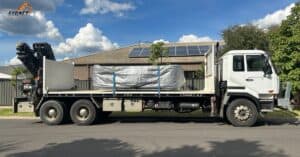
A crane truck can be a practical solution for relocating large signs around commercial buildings, warehouses, factories and retail premises.
Unlike a standard delivery truck, a crane truck has a mounted lifting system that can raise and lower suitable loads. This can help when a sign needs to be moved from one side of a building to another, especially when ground access is limited.
Depending on the site’s layout and the crane’s capabilities, a crane truck may be able to lift the sign over certain obstacles and position it near its new mounting location.
Benefits include:
- Efficient lifting: Suitable signs can be lifted without relying on manual handling alone.
- Controlled positioning: Operators can carefully guide the sign into the required position.
- Reduced handling: Mechanical lifting can reduce the need to carry bulky signage between locations.
- Convenient transport: The truck can transport the sign when it must be moved to another part of the property or to a different site.
The crane must have sufficient lifting capacity at the required reach. A sign’s large surface area can also make it vulnerable to wind, so weather conditions must be assessed before lifting.
3. Prepare the Building and Work Area
Preparing the site helps reduce delays and supports safe lifting operations.
First, clear the area around the sign and the intended destination. Make sure the crane truck has enough room to park and deploy its stabilisers on suitable ground.
Check for overhead powerlines, balconies, trees, awnings and other obstructions. If the sign is illuminated, electrical connections must be isolated and disconnected by a suitably qualified professional before removal.
You should also consider pedestrian access, nearby vehicles and business operations. Barriers and appropriate traffic or pedestrian management may be necessary to keep people away from the lifting area.
If the sign needs to be installed on the side of a building, inspect the proposed mounting location to confirm that the supporting structure and fixings are suitable.
4. Remove, Lift and Reposition the Sign
Large signs should be removed and lifted by appropriately trained personnel using suitable equipment.
The team should identify approved lifting points and select slings or other lifting accessories suitable for the sign’s weight and design. The sign must be supported properly to prevent bending, twisting or damage to its frame.
Once the sign has been detached, the crane operator can lift it in a controlled manner and move it towards the new location, provided the planned lift is within the crane’s capabilities.
Workers should remain clear of suspended loads and never stand underneath the sign. Once it reaches its destination, the sign should be secured using suitable mounting hardware before the lifting equipment is removed.
5. Consider Costs and Planning Requirements
The cost of moving a large sign depends on its size, weight, installation height, crane requirements and site accessibility. Additional expenses may include electrical work, mounting hardware, permits and traffic management.
Request a quote after providing the sign’s measurements, photographs and details of the building layout. This allows the transport provider to assess the job and recommend suitable equipment.
Conclusion
Moving a large sign to the side of a building requires careful planning, proper lifting equipment and experienced personnel. A crane truck can make the process more efficient by lifting and positioning suitable signage while reducing the need for manual handling.
Before arranging the move, confirm the sign’s weight, inspect both locations and ensure the crane has sufficient capacity and reach. With the right preparation and professional assistance, you can relocate your sign safely and position it where your business needs it.